A regenerative treatment for erectile dysfunction and Peyronie's disease — incision-free, anesthesia-free and outpatient. It targets vascular renewal.
Low-intensity shockwave therapy (Li-ESWT) works with weak acoustic waves applied externally to the penile tissue. These waves create a controlled "renewal stimulus" in the tissue: they trigger the formation of new blood vessels (neovascularization), support the function of existing vessels, and activate stem cells within the tissue.
The most common cause of erectile dysfunction is insufficient blood flow to the penis. Unlike medications, ESWT aims to provide a lasting benefit by improving the vascular structure rather than a temporary effect. In this respect it falls under "regenerative urology".
The treatment is entirely outpatient; it requires no incision, needle or anesthesia. The patient returns to daily life immediately after the procedure.
ESWT stands out especially in vascular-origin erectile dysfunction. Suitable candidate groups:
The probe is placed externally on the surface of the penis. Low-intensity shockwaves spread into the tissue and stimulate the formation of new blood vessels (neovascularization). There is no incision or needle.
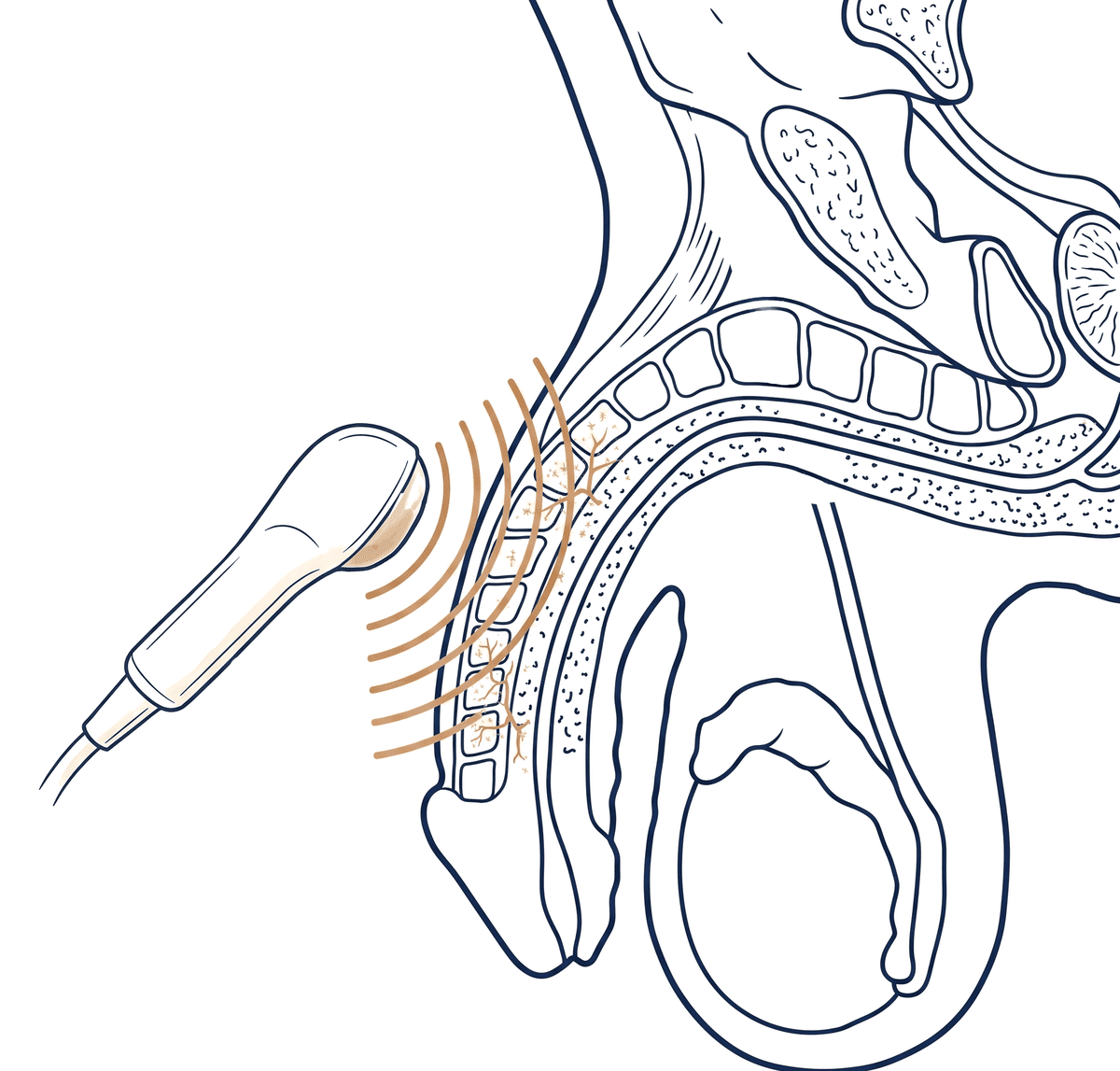
ESWT is a series of sessions. Each stage proceeds according to plan; response is monitored with interim assessments.
An erectile function questionnaire (IIEF), penile Doppler ultrasound and general health assessment are performed.
The number and interval of sessions are determined by the severity of the complaint. A program of usually 6–12 sessions is applied.
The probe is placed at different regions along the penis. Each session lasts 15–20 minutes, is painless and outpatient.
The treatment effect gradually becomes clearer over weeks. Response is assessed at the end of the program; a booster session is planned if needed.
The main advantages ESWT offers compared with surgery and continuous medication.
Requires no incision, needle or anesthesia. Applied from outside the body without harming the tissue.
While medications provide a temporary effect, ESWT aims for lasting improvement by stimulating vascular renewal.
You can return to work and normal activity immediately after a session. No recovery period is needed.
It does not conflict with existing medication; it can be applied as a complement when needed.
No serious side effects have been reported. Rarely, no problem beyond temporary mild redness is seen.
In Peyronie's disease it can contribute to both reducing pain and softening the plaque.
The most common questions about duration of effect, pain and durability of results.
No. The waves used are low-intensity (regenerative) waves; they differ from the high-energy waves used to break kidney stones. Most patients feel only a mild vibration. No anesthesia is needed.
The effect of ESWT is not immediate; because tissue renewal takes time, improvement usually becomes clear in the later weeks of the sessions and in the 1–3 months after treatment ends.
Because ESWT aims to improve the vascular structure, the benefit obtained is long-lasting. However, if the underlying cause (diabetes, vascular disease, smoking) continues, a booster session may be needed over time.
ESWT is most effective in vascular-origin erectile dysfunction. Hormonal, neurological or psychological causes may require different treatments. Therefore, correctly determining the cause first is essential.
A standard program usually consists of a total of 6–12 sessions, 1–2 per week. The exact number is individualized according to the severity of the complaint and the response obtained.
The right treatment starts with the right diagnosis. Let's assess the cause of your erectile dysfunction together and plan the most suitable approach. Reach out via WhatsApp for a preliminary consultation.