Anatomy
The testicle's place in the urogenital system
The testicles are organs that produce sperm and testosterone. Cancer usually begins in a single testicle as a painless mass; this is why self-examination is of great importance.
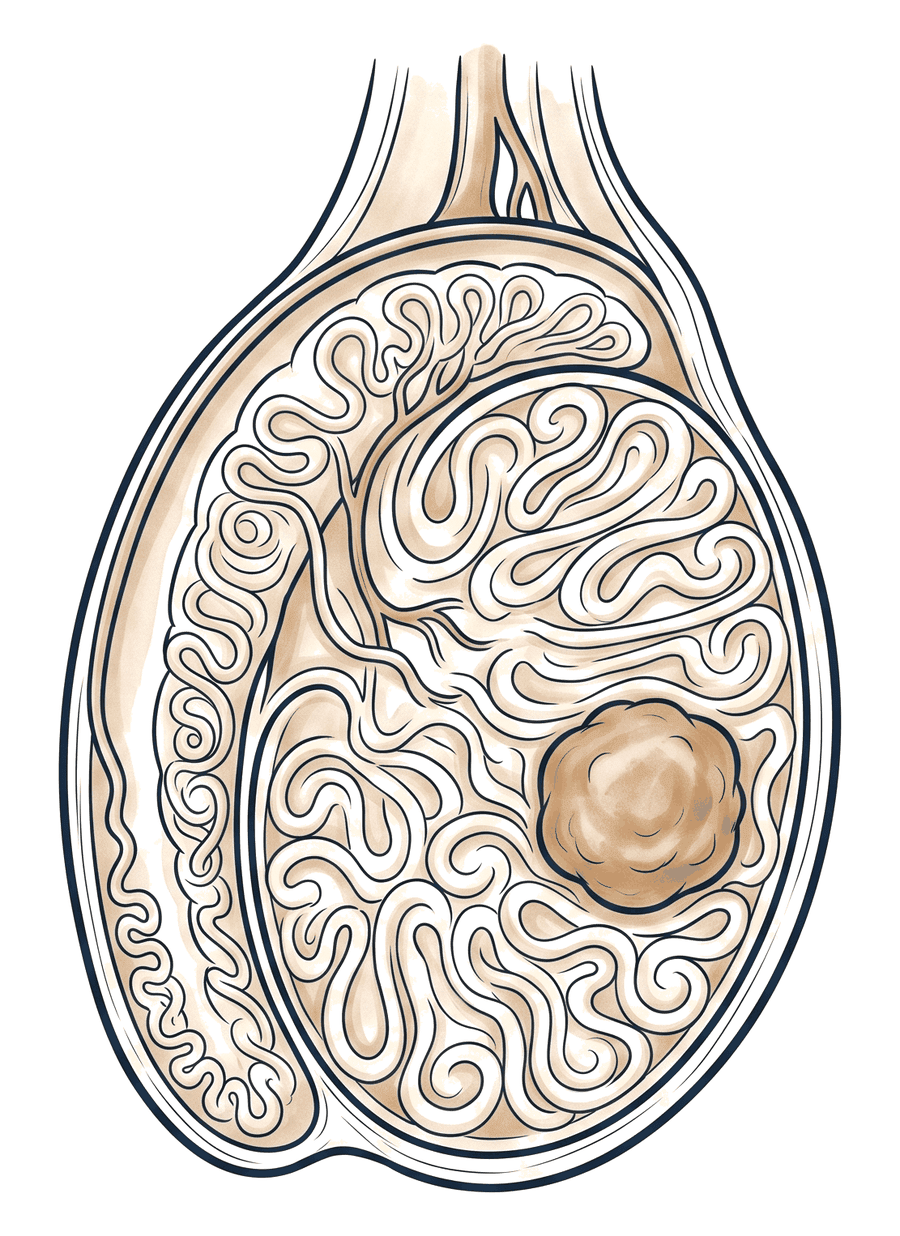
The most common cancer in young men — but also one with the highest treatment success. The way to catch it early: self-examination.
Testicular cancer is a cancer that develops from the testicular tissue, which produces sperm and the male hormone. Unlike many other cancers, it is most common in young men aged 15–40.
The most important message is this: testicular cancer is one of the most treatable cancers. When caught at an early stage the recovery rate is very high; even if the disease has spread, high success is achieved with modern treatments. That is why, instead of postponing out of fear, seeking help early changes everything.
The most common symptom of testicular cancer is a painless firmness or swelling in the testicle. For this reason, young men performing a testicular self-examination once a month is the most effective method for early diagnosis.
The testicles are organs that produce sperm and testosterone. Cancer usually begins in a single testicle as a painless mass; this is why self-examination is of great importance.
Any newly appearing change in the testicle should be assessed. The absence of pain does not make it unimportant — on the contrary, it is typical.
A palpable, painless firmness or nodule in the testicle — the most common and most important symptom.
One testicle enlarging compared with the other, or changing in shape.
A feeling of fullness or heaviness in the scrotum.
A mild, dull pulling or discomfort in the lower abdomen or groin.
A sudden build-up of fluid in the scrotum (a hydrocele-like swelling).
In some cases, tenderness may be seen in the testicle or the chest area.
Diagnosing testicular cancer is fast. In case of suspicion, the first and most important step is ultrasound.
The features of the mass in the testicle are assessed by hand; a suspicious finding starts further investigation.
Testicular ultrasound is the most important first imaging showing the presence and features of the mass.
Blood markers such as AFP, beta-hCG and LDH help in diagnosis, type and follow-up.
After diagnosis, staging is done with tomography to determine whether the disease has spread.
The most common questions about self-examination, fertility and treatment success.
Do it once a month, ideally after a warm shower (when the scrotum is relaxed). Gently roll each testicle between your thumb and other fingers. You are looking for a painless firmness, a nodule, or a change in size/consistency. If you notice a new change, seek help without delay.
No. Many benign causes such as a cyst, a dilated vein (varicocele) or inflammation can also produce a palpable change. However, only examination and ultrasound can tell the difference. That is why being assessed, rather than "waiting," is important.
Usually no. The other healthy testicle can continue hormone and sperm production; sexual function and fertility are preserved in most patients. Still, before treatment, the option of sperm freezing (banking) can be discussed to preserve fertility.
Yes. Testicular cancer is one of the cancers where modern oncology is most successful. The recovery rate at an early stage is very high; even if the disease has spread, success rates are high thanks to its good response to chemotherapy.
This is a very common feeling, but postponing is the biggest risk. The assessment is confidential, fast and largely painless. Seeking help early both makes treatment easier and puts your mind at ease. This is a sign of strength, not weakness.
Testicular cancer is one of the cancers with the highest recovery rate when acted on early. Let's assess a change you have noticed, in confidence. You can reach out via WhatsApp for a preliminary consultation.